



The e-commerce landscape has transformed dramatically over the last decade, tearing down the traditional barriers to entry for aspiring entrepreneurs. You no longer need thousands of dollars in upfront capital, a massive warehouse, or a complex logistics network to start a retail business. Thanks to the dropshipping model and the robust ecosystem of the Shopify platform, anyone with an internet connection and a solid strategy can build a highly profitable online storefront. Pick out the best dropship app for shopify.
However, the secret to scaling a modern e-commerce business isn’t just about having a great looking website; it relies heavily on the technology operating behind the scenes. This is where leveraging the right Shopify dropshipping apps becomes the critical difference between a store that struggles to process a few orders a week and one that smoothly processes thousands of dollars in daily sales while you sleep.
In this comprehensive guide, we are going to dive deep into the world of shopify apps tailored specifically for dropshippers. We will cover everything from product research and supplier selection to backend logistics, inventory syncing, and profit tracking. Whether you are launching your first store or looking to optimize an existing six-figure brand, this masterclass will provide you with the actionable insights you need to succeed.
Phase 1: The Foundation of a Profitable Dropshipping Store
Before you start installing dozens of applications, it is essential to understand what these tools are actually designed to do. Dropshipping is a fulfillment method where a store doesn’t keep the products it sells in stock. Instead, when a store sells a product, it purchases the item from a third party—usually a wholesaler or manufacturer—and has it shipped directly to the customer.
The primary challenge of this business model is managing the moving parts. You are the middleman coordinating between the customer and the supplier. Without automation, you would be manually copying customer addresses, pasting them into supplier websites, paying for orders one by one, and manually updating tracking numbers.
Shopify dropshipping apps solve this by acting as the digital bridge between your storefront and your suppliers’ warehouses. They automate data transfer, sync inventory levels, and streamline the fulfillment process.
The Importance of Product Selection
Even the most perfectly automated store will fail if nobody wants to buy what you are selling. Your first technological investment should be in discovering what the market currently demands. Instead of guessing what might sell, successful store owners rely on data.
Using specialized winning product research tools for stores, you can analyze thousands of products across social media platforms and global marketplaces. Tools like Minea, Peeksta, or Dropship.io allow you to see which ads are currently trending on Facebook and TikTok, giving you real-time data on consumer engagement. These tools show you:
- Engagement rates on competitor advertisements.
- Estimated daily sales of trending products.
- The exact suppliers where you can source these items.
Actionable Tip: Look for products that solve a specific problem, have a “wow” factor that stops people from scrolling, and offer enough room for a healthy profit margin (ideally a 3x markup from your cost of goods).
Phase 2: Sourcing Your Products and Choosing Suppliers
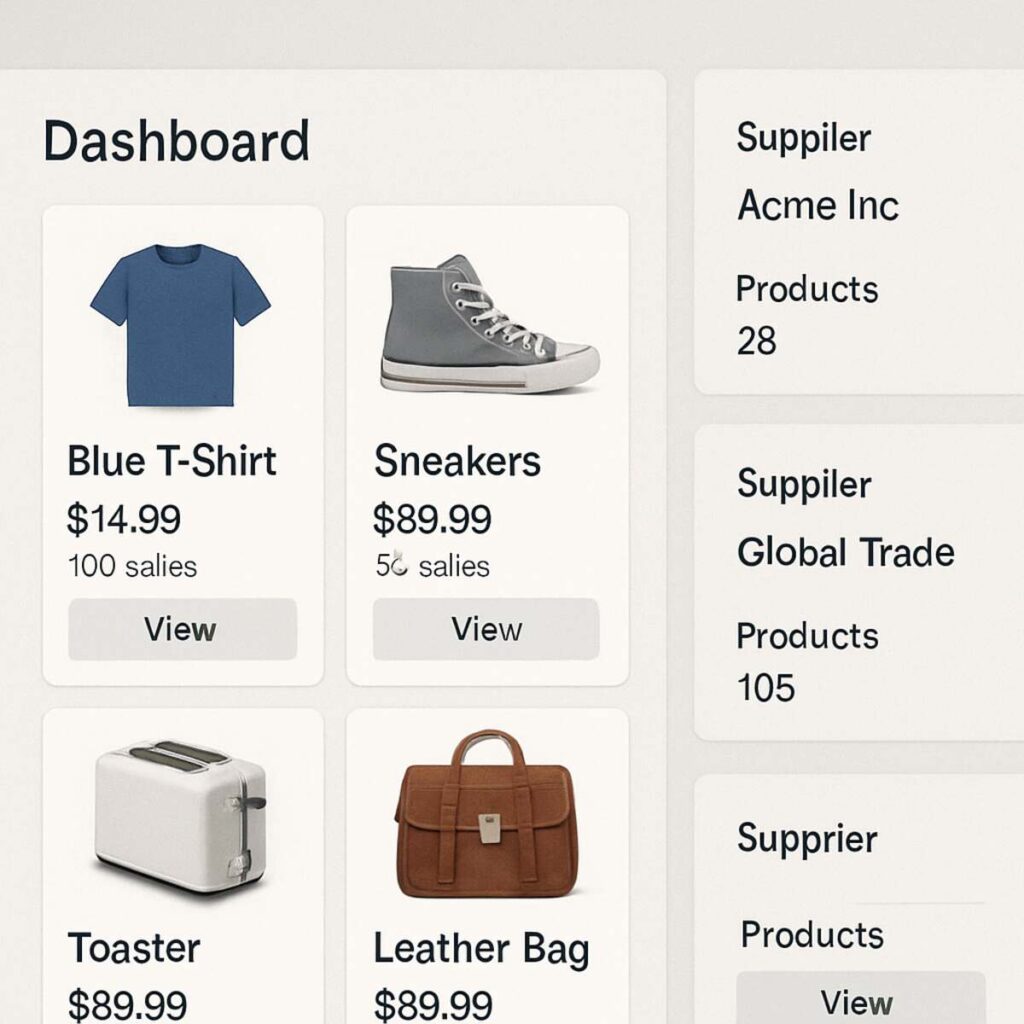
Once you know what you want to sell, you need to find a reliable partner to supply it. The market shifted significantly a few years ago when Oberlo, the original pioneer of dropshipping apps, shut down. This left many entrepreneurs asking: what are the best Oberlo alternatives on the market today?
Fortunately, the current generation of sourcing apps is vastly superior, offering faster syncing, better supplier vetting, and more intuitive interfaces.
The AliExpress Ecosystem and Automation
For years, AliExpress has been the go-to testing ground for dropshippers due to its massive catalog and low prices. If you are building a general store or testing multiple products, you need a streamlined method for importing products from AliExpress to Shopify.
Currently, the official and most popular app for this is DSers. DSers revolutionized the way merchants interact with AliExpress by allowing for bulk ordering—a feature that was notoriously clunky in older apps. With just a few clicks, you can import a product’s images, descriptions, and variants directly into your Shopify dashboard.
The Great Sourcing Debate: DSers vs. Spocket
As you mature as a dropshipper, you will likely find yourself comparing different sourcing platforms to find the best fit for your brand’s growth. A common comparison merchants look for is a comprehensive DSers vs Spocket review.
- DSers: Best for merchants who rely heavily on AliExpress. It is incredibly efficient for processing hundreds of orders at once. However, because it relies on Chinese suppliers, shipping times can range from 10 to 20 days. It is a fantastic starting point when you are testing products on a budget.
- Spocket: Spocket was built to solve the shipping time problem. It is a marketplace that specifically vets suppliers based in the US, Europe, and Australia. If you are focused on finding US based dropshipping vendors, Spocket is a premium choice. The products are generally higher quality, and shipping can take as little as 2 to 5 days.
The choice between the two usually comes down to your business model. If you are competing on price and volume, DSers is the winner. If you are building a premium, long-term brand where customer experience is paramount, Spocket’s fast local shipping is worth the slightly higher product costs.
A Rising Star: CJ Dropshipping
Another incredible platform that bridges the gap between affordable Chinese manufacturing and fast global shipping is CJ Dropshipping. CJ operates differently than AliExpress; they actually source the products, hold inventory in their own warehouses (including overseas warehouses in the US and Germany), and fulfill the orders for you.
Integrating CJ Dropshipping with Shopify is seamless via their dedicated app. Once connected, you can list their products on your store. When an order comes in, CJ automatically pulls the data and processes it. Because they own their logistics network, they often provide faster and more reliable shipping lines (like CJPacket) than standard ePacket shipping, making them an excellent middle-ground alternative.
Finding the Best Free Dropshipping Suppliers for Beginners
If you are bootstrapping your business with limited capital, you want to avoid apps with high monthly subscription fees until your store is generating consistent revenue. So, what are the best free dropshipping suppliers for beginners?
- Zendrop (Free Tier): Zendrop offers a fantastic free plan that gives you access to over 1 million products. They offer automated fulfillment and 24/7 support.
- CJ Dropshipping: Completely free to use. You only pay for the cost of the product and shipping when an order is placed.
- AliExpress via DSers (Basic Plan): You can process unlimited orders on DSers’ free plan, making it the most cost-effective way to start a high-volume testing store.
Phase 3: Elevating the Customer Experience with Fast Shipping
The biggest complaint customers have about dropshipped products is the wait time. In the age of Amazon Prime, expecting a customer to wait three weeks for a package is a surefire way to generate negative reviews, high return rates, and payment gateway holds.
The Necessity of Fast Delivery
Reducing long shipping times for customers should be your primary operational goal once you have found a winning product. Long shipping times lead to an influx of customer service emails (“Where is my order?”), which drains your time and resources.
Strategies for Local Sourcing
To achieve 3-to-5 day delivery windows, you must shift your supply chain locally. As mentioned earlier, finding US based dropshipping vendors (or vendors local to your target market, such as UK suppliers for a British audience) is the most effective strategy.
Apps like Zendrop (on their paid plans), Spocket, and Syncee allow you to filter suppliers by location. Furthermore, once you are consistently selling 10-20 units of a product per day, you can contact private sourcing agents. A private agent will buy your product in bulk directly from the factory in China, store it in a local fulfillment center in your target country, and ship it via fast local couriers (like USPS or Royal Mail) when an order is placed.
Phase 4: Exploring Niche Dropshipping Models
Standard low-ticket dropshipping from China is just one way to utilize Shopify. Many successful entrepreneurs prefer to pivot into specialized models that offer different advantages.
High-Ticket Dropshipping
Instead of selling hundreds of $20 items, what if you sold five $2,000 items? High-ticket dropshipping involves selling premium goods—such as commercial espresso machines, luxury chandeliers, or outdoor greenhouses—directly to consumers or businesses.
Because these items are expensive, they require local, brand-approved suppliers. You cannot source a $3,000 sauna from AliExpress. To succeed in this niche, you need to use high ticket dropshipping supplier directories. Platforms like Inventory Source connect you directly with authorized distributors and manufacturers of premium brands. You essentially become an authorized online dealer for established companies. The margins are incredible (often $500 to $1,000 profit per sale), but it requires excellent customer service and professional phone support.
Print on Demand (POD)
If you are a creative individual looking to build a unique apparel or lifestyle brand without holding inventory, Print on Demand is the perfect model. Instead of selling generic items, you place your own custom designs on blank products (t-shirts, mugs, phone cases, blankets).
Using print on demand services for Shopify like Printful or Printify, your store becomes fully automated. When a customer buys your custom-designed hoodie, the order is routed to a POD facility. They print your design onto the blank hoodie, package it, and ship it directly to your customer under your brand name. This model boasts incredibly high customer satisfaction because the products are unique and usually printed locally in the US or Europe.
Phase 5: Automating Your Backend Operations
As your daily order volume grows from five orders to fifty, and then to five hundred, manual data entry becomes mathematically impossible. Scaling requires ironclad backend operations. If your logistics break down, your business breaks down.
True Automation in Fulfillment
Knowing how to automate Shopify fulfillment is what transitions you from a self-employed worker into a true business owner. When a customer pays you, you want the supplier to be notified instantly, the product to be picked and packed, and the tracking number to be automatically emailed to your customer—all without you clicking a single button.
Apps like DSers, AutoDS, and Zendrop all offer auto-fulfillment toggles. Once you link a payment method (like a high-limit business credit card) to the app, you can set it to automatically pay the supplier the moment a Shopify order comes in.
Processing at Scale
When you hit the scaling phase, you need robust bulk order processing software. Manually paying for 300 orders one-by-one, even within an app, is tedious and poses a risk of payment processors blocking your card for suspicious rapid-fire activity. Bulk processing allows you to combine hundreds of customer orders into a single, consolidated payment to your supplier. DSers excels at this, allowing you to pay for up to 300 AliExpress orders with a single click.
Inventory Synchronization
One of the most dangerous pitfalls in dropshipping is selling a product that your supplier has already run out of. Refunding angry customers hurts your reputation and your merchant processor standing.
To prevent this, you must integrate robust inventory management tools. These tools monitor your supplier’s stock levels in real-time. If the supplier’s stock drops to zero, the app automatically updates your Shopify product page to display “Out of Stock,” preventing any further purchases.
Reliable inventory synchronization tools for e-commerce, such as Stock Sync or Syncee, are essential. They update your inventory data via FTP, URL, or API feeds on an hourly or daily basis. This ensures that the quantity available on your storefront perfectly mirrors what is actually sitting on the warehouse shelf.
Orchestrating Multiple Supply Chains
As you expand your product catalog, you will likely rely on more than one supplier. You might have your best-seller sourced through a private agent on CJ Dropshipping, a secondary product sourced from a local US vendor on Spocket, and an upsell product managed via Printful.
Managing multiple suppliers in one dashboard is critical to avoid administrative chaos. Apps like OrderMetrics or ShipStation can be configured to intelligently route orders. If a customer buys Product A and Product B, the software knows to send the fulfillment request for Product A to Supplier 1, and the request for Product B to Supplier 2, all while keeping the Shopify order screen organized for your customer service team.
Phase 6: Financial Tracking and Pricing Strategies
A store that generates $100,000 in revenue but spends $101,000 on ads, software, and product costs is a failing business. Revenue is a vanity metric; profit is sanity.
Calculating Your True Profit
Because dropshippers heavily rely on paid advertising (like Facebook, TikTok, and Google Ads), it is remarkably easy to lose track of your margins. The default Shopify dashboard shows your total sales, but it does not automatically deduct your daily ad spend, transaction fees, shipping costs, or app subscriptions.
To maintain a healthy business pulse, you need automated profit margin calculator tools. Apps like Lifetimely, TrueProfit, or BeProfit connect directly to your Shopify store, your supplier apps, and your advertising accounts. They pull all this data into one unified dashboard to show you your exact net profit down to the penny, in real-time.
Actionable Tip: Check your automated profit dashboard twice a day. If you notice a specific ad campaign is suddenly eating into your margins, you can pause it immediately rather than waiting until the end of the month to realize you lost money.
Setting the Right Price
Your pricing strategy dictates your ability to scale. A common mistake beginners make is pricing products too low to “beat the competition.” In reality, whoever can spend the most to acquire a customer wins.
When configuring your pricing rules within your dropshipping apps, aim for a minimum of a 60% gross margin. If a product costs you $10 to buy and ship, sell it for at least $29.99. This gives you $20 of gross profit to cover your marketing costs, taxes, and still leave net profit in your pocket. Many apps allow you to set global pricing rules—for example, automatically multiplying the supplier’s cost by 3 to generate your retail price.
A Step-by-Step Guide to Setting Up Your Dropshipping App Stack
To summarize all this information into a practical roadmap, here is exactly how you should structure your Shopify apps from day one to ensure a smooth, automated workflow.
Step 1: Install a Sourcing App Determine your strategy. If you are going broad and cheap for testing, install DSers. If you want faster shipping for a branded feel, install Spocket or connect CJ Dropshipping.
Step 2: Connect Your Product Research While you don’t necessarily install research tools into Shopify, you should have a workflow where you use external software to find winners, and then immediately search for those specific products in your sourcing app.
Step 3: Import and Optimize Push the product from your sourcing app to your Shopify store. Crucial: Do not use the supplier’s default product titles and descriptions. They are usually stuffed with keywords and written in broken English. Rewrite them to focus on the customer’s emotional desires and the benefits of the product.
Step 4: Set Up Inventory Syncing Go into your sourcing app settings and turn on the “Auto-update inventory” feature. Ensure that if the supplier changes the price of the item, your retail price automatically updates to maintain your profit margin.
Step 5: Automate Fulfillment Rules Add your business credit card to the sourcing app. Turn on auto-fulfillment so that orders are processed without manual intervention.
Step 6: Install Financial Tracking Install an app like TrueProfit. Connect your Facebook/TikTok ad accounts so you can track your exact Return on Ad Spend (ROAS) and daily net profit.
Step 7: Add Customer Retention Apps Once the core dropshipping mechanics are handled, install apps for email marketing (like Klaviyo) and SMS marketing to re-engage past customers. Selling to an existing customer is always cheaper than acquiring a new one.
Common Pitfalls and How to Avoid Them
Even with the best software stack in the world, dropshipping requires keen business acumen. Avoid these common traps that catch new entrepreneurs:
- Selling Trademarked Goods: Never dropship products that feature logos from major brands (Nike, Disney, Marvel) unless you are using authorized high-ticket directories. Selling counterfeit goods will get your Shopify store and payment gateways permanently banned.
- Ignoring Quality Control: Just because the pictures look great doesn’t mean the product is high quality. Once a product starts selling well, order a sample to your own house. Test it. Take custom photos of it. If it’s junk, your customers will charge back their credit cards.
- Overloading on Apps: While shopify apps are powerful, installing 40 different apps will drastically slow down your website’s loading speed. A slow website destroys conversion rates. Only install apps that directly contribute to sourcing, fulfilling, or increasing conversions. Delete anything you aren’t actively using.
Conclusion: Building a Sustainable Asset
The beauty of building an e-commerce brand today is the unprecedented access to world-class software. By intelligently utilizing Shopify dropshipping apps, you are essentially hiring a digital team of warehouse workers, accountants, and logistics managers for a fraction of the cost of real-world employees.
Success in this industry is no longer about who can work the hardest manually entering tracking numbers; it is about who can build the most efficient, automated, and customer-centric system.
By taking the time to master winning product research tools for stores, carefully selecting your suppliers (whether that’s through importing from AliExpress, utilizing CJ Dropshipping, or finding domestic vendors), and implementing strict inventory management tools and profit calculators, you lay the groundwork for a scalable, highly profitable online enterprise. Stop trading time for tedious tasks. Let the software do the heavy lifting, and focus your energy on what truly matters: marketing, brand building, and delighting your customers.
